
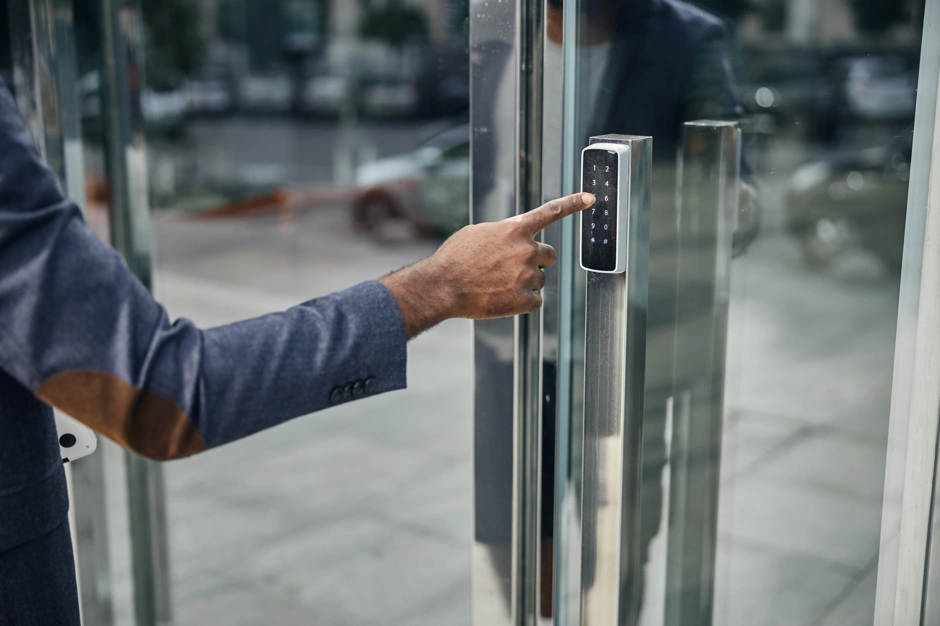
A modern building moves more people through its doors in a week than an older property handled in a month. Staff, tenants, vendors, cleaners, and delivery drivers all need a way in, and each one carries a level of risk that changes by the hour. Access control systems matter because they let a building stay open for business while staying closed to everyone with no reason to walk through the door.
Access Control Systems Decide Who Enters Your Building and Who Stays Out
The setup is simpler than most owners expect. A reader on the wall checks a credential, a controller confirms whether that person holds permission for that door, and the lock releases or stays shut. The decision takes under a second.
What changes for the building is where permission lives. Entry belongs to a named person rather than an object, so the owner grants, limits, or withdraws it from a screen at any time. A shop manager can hold entry to the front door and stock room while a part-time cashier holds the front door alone, and both arrangements exist inside the same building without extra hardware.
That structure scales with the property. A single storefront needs two doors covered. A four-floor office with tenants, cleaners, and a shared lobby might need thirty. The logic behind each door stays the same.
Access Control Systems Keep Sensitive Rooms Closed to Most of Your Staff
Every building holds a few rooms that carry most of the value. A server room, a cash office, a pharmacy cabinet, a records store, a tool crib, or a walk-in freezer holding product. The people who need those rooms are usually a short list, while the people who need the building are a long one.
Zone permission handles this split. A warehouse worker reaches the loading dock and break room without reaching the finance office. A dental practice separates the waiting area from patient records and the medication cabinet. A restaurant keeps the walk-in and liquor storage on a manager-only list while the kitchen stays open to all shift staff.
Setting this up costs nothing beyond a few minutes of configuration, and a role change updates the same day somebody gets promoted or moves department.
Also Read: What is a Master Key System and How Does It Work?
Every Entry Creates a Verifiable Record That Serves as Evidence
Each credential presented at a reader writes a line to the log carrying a name, a door, a date, and a time. That record becomes the most used feature in the system, though owners rarely predict it during installation.
Take a supply room where stock keeps shrinking. The report names the person and the minute, so the conversation moves from suspicion to fact without accusing anyone unfairly. The same record answers questions across the rest of the property:
- Confirming a driver reached the dock at the time written on the delivery paperwork
- Showing who entered a mechanical room the night a pipe failed
- Supporting or challenging a claim about hours worked on site
- Proving a contractor arrived and left within the agreed window
- Backing an insurance claim with a documented entry history
Buildings without this record carry every one of those conversations on memory, and memory rarely holds up when money is involved.
Access Control Systems Let You Grant Entry for Hours Instead of Forever
Permission does not have to be permanent. A credential can work Tuesday between 8 a.m. and 6 p.m. and refuse the same door on Sunday at midnight. That control removes a large share of the exposure inside commercial property.
Timed Credentials Keep Contractors and Cleaners Inside Their Own Window
HVAC contractors visit for two days. Cleaning crews arrive after closing. Seasonal staff work November through January. Each of them receives entry that expires on a date you set, which ends the task of chasing somebody weeks after the job finished. Nobody carries entry into a period they no longer need it.
Scheduled Locking Secures the Building Without Staff Staying Late
Doors can unlock at opening time and secure themselves at close. A manager stops driving back to check whether the last person out locked up, since the system reports the building secured on schedule. For properties running early deliveries or evening shifts, the schedule handles both without anyone holding a spare key.
Access Control Systems Update Permissions the Same Day Your Team Changes
Staff movement is constant in retail, hospitality, healthcare, and warehousing. A restaurant with twenty employees and heavy turnover processes people in and out all year, and every change carries a security decision.
Electronic entry handles all three movements in under a minute. A new hire receives a credential on their first morning. Someone moving from the floor to the office picks up new room permissions without new hardware. A departure closes entry the same hour, so nothing stays open while somebody looks for a returned key.
No cylinder gets touched during any of this. No door sits exposed. No invoice arrives from a hardware supplier. Buildings running a master key system often keep that mechanical structure on back-of-house openings while main entrances and sensitive rooms move onto credentials, and the two arrangements run together without conflict.
Controlled Entry Puts Every Property You Manage on One Screen
Property managers rarely handle one address. Somebody running four buildings across Philadelphia and nearby areas such as Upper Darby, Drexel Hill, and Cheltenham spends a large share of the week driving between them for small tasks.
A cloud platform removes most of those trips. Entry gets granted from a desk, a door gets released for a delivery from a phone, and a credential gets cancelled while the manager stands in a different borough. Reports for all four buildings open in the same dashboard, which makes comparing activity across sites straightforward.
Access Control Systems Release Doors Instantly During a Fire Alarm or Power Failure
Controlling entry into a building can never block exit from it. This point carries as much weight as any security benefit, and it decides whether an installation passes inspection.
Electronic locks behave in two ways. Fail-safe hardware releases when power drops, while fail-secure hardware holds. Stairwell doors, exit routes, and openings held by magnetic locks generally need to release during a power failure or an alarm signal, since occupants must leave without a credential in hand.
A correct installation brings several pieces together:
- Connection to the fire alarm panel so magnetic locks release on activation
- Request-to-exit sensors or push bars that free the door from the inside at all times
- Manual release buttons placed where people find them under stress
- Battery backup so the system keeps running through short outages
- Exit hardware that opens with one motion rather than two separate actions
The same platform supports the opposite command. A school, clinic, or office can lock every exterior door from one button during an incident, which no set of keys can achieve at speed.
Access Control Systems Satisfy the Entry Records Auditors and Regulators Ask For
Regulation now settles the question for many owners. Medical practices, billing companies, and any business handling patient records fall under the HIPAA Security Rule, which calls for physical safeguards limiting facility access to systems holding protected health information. The requirements appear in the HHS guidance on the Security Rule, and an auditor asking who entered a records room last quarter expects a report rather than an assurance.
Similar expectations apply across other sectors:
- Businesses processing card payments must restrict physical entry to areas holding cardholder data
- Cannabis operators in legal states face strict entry logging and camera requirements
- Schools and childcare centers need controlled vestibules and visitor management
- Government contractors handling controlled information must document who reached secured spaces
The reports these rules call for already exist inside the platform. Compliance becomes a matter of exporting a file rather than reconstructing a year from staff recollection.
Access Control Systems Match Each Door to the Credential It Needs
Every door carries a different risk level, and matching the method to that level keeps the project affordable while covering what matters.
- Keypad and PIN entry suit low-traffic doors such as storage rooms and rear staff entrances where budget carries more weight than tracking individuals
- Proximity cards and fobs remain the workhorse for offices, gyms, and apartment lobbies since they cost little to replace and staff learn them in a minute
- Encrypted smart cards protect laboratories, financial firms, and government contractors where a copied credential creates serious exposure
- Mobile credentials on a phone remove card printing and card loss, which fits shared workspaces and teams moving between sites
- Biometric readers using fingerprint or facial recognition matter in pharmacies, cash rooms, and server rooms where a shared credential defeats the purpose
- Video intercom entry covers lobbies where somebody must confirm identity before the door releases
Most buildings run two or three of these together. A lobby might use fobs for tenants and video intercom for visitors, while the server room upstairs limits entry to four fingerprints.
Controlled Entry Ties Your Cameras, Alarms and Intercoms Into One Response
Security equipment installed at different times tends to sit in separate silos. A camera records footage nobody reviews, and an alarm panel operates on a code somebody wrote on a sticky note.
Modern platforms pull these together. Camera footage attaches to the entry event, so reviewing a door opening takes one click rather than an hour of scrubbing through recordings. Alarm systems arm and disarm by credential, which removes shared codes from circulation. Visitor management links to the front desk, and larger properties connect tenant or staff directories so permissions update when a record changes.
The value here is response speed. When something happens at 2 a.m., the building tells you which door, which credential, and what the camera saw at that second.
Also Read: How a Commercial Locksmith Protects Your Philadelphia Business?
Access Control Systems Cut the Security Costs Your Building Repeats Every Year
Owners look at the installation figure and stop reading. The comparison worth running covers three to five years of operation.
Rekeying leaves the budget as a recurring line. A business rekeying two or three doors twice a year after staff changes pays that bill every cycle, and the spending ends once credentials take over.
Manager hours return next. Opening and locking the building, waiting for contractors, and tracking down key holders all move to the schedule or the phone. Insurance carriers sometimes reduce premiums for properties with documented entry control and camera coverage, though the amount varies by carrier and policy, so the question belongs in your next renewal conversation.
Loss avoidance carries weight too. FBI figures for 2024 show burglaries of residential properties made up 52.1 percent of all burglary offenses, according to the FBI Crime Data Explorer, leaving a large share striking shops, offices, and warehouses. A single incident often costs more than the system that would have prevented it.
Controlled Entry Makes Late Shifts and Lone Working Feel Safer
There is a human side owners rarely say out loud. A nurse closing a clinic at nine, a shop assistant counting a register alone, and a tenant crossing a lobby at midnight all carry the same quiet worry about who might follow them inside.
Controlled entry removes that worry from the daily routine. Staff stop propping doors for convenience because their own credential works instantly. A manager stops lying awake wondering whether the building was secured. Employees notice this quickly, and people stay longer in workplaces where walking out to the car at night feels safe.
Access Control Systems Hold Tenants Longer in Apartment and Condo Buildings
Residential properties gain from the same technology, with priorities shifting toward turnover and daily convenience. When a tenant moves out, deactivating the credential closes the exposure the same afternoon, and the unit turns over without a locksmith visit.
Common areas carry most of the benefit:
- Lobby and vestibule doors with video intercom so residents see visitors before releasing entry
- Package rooms that log every pickup, which cuts disputed deliveries
- Laundry rooms and gyms limited to residents rather than anyone walking past
- Parking garages with vehicle credentials that open gates without a card in hand
- Roof and mechanical access restricted to maintenance staff
Buildings offering these features lease faster and hold tenants longer, since renters compare security amenities the same way they compare appliances.
Keyless Entry Protects Family Homes Without a Spare Key Outside
Homeowners use a smaller version of the same idea. A keyless entry lock removes the hidden spare under the mat, which burglars check first. Parents give children a code rather than a key that gets lost at school, and a temporary code covers a dog walker or a contractor for one week.
The weight lands differently at home. A parent at work wants to know the child reached the house safely, and a phone notification when the front door opens at 3:20 p.m. answers that every school day.
Access Control Systems Fit Older Buildings Without Opening Walls or Ceilings
Owners often delay because they picture construction. Modern hardware removes most of that concern, so the age of a property no longer justifies leaving entry uncontrolled.
Wired systems still deliver the strongest reliability at main entrances and high-security rooms, since power and data reach a central controller. Wireless locks cover interior doors, closets, and offices where cable runs would cost too much. A mixed design keeps the budget sensible while covering every opening that matters.
Existing hardware shapes the plan. Aluminum storefront doors accept electric strikes and concealed rods. Hollow metal doors accept electrified mortise locks. Wood interior doors often take battery-powered wireless locksets. A site survey before quoting prevents surprises once work begins.
Your Building Still Cannot Tell You Who Walked In Last Night
Right now you cannot prove who entered your property after closing. That gap stays invisible until stock goes missing, a tenant files a complaint, or an insurance adjuster asks a question you have no answer for. Every week of delay puts more credentials outside your control and adds more nights with no record at all, and finding out the hard way always costs more than the system would have.
We at Affordable Lock & Key install and service access control systems for offices, retail spaces, warehouses, medical practices, apartment buildings, and homes across Philadelphia, Upper Darby, Drexel Hill, Springfield, Lansdowne, Cheltenham, and nearby communities. Our licensed and insured technicians handle keypads, card readers, mobile credentials, video intercoms, electric strikes, magnetic locks, and fire alarm integration, along with the door hardware behind them. Contact Affordable Lock & Key for a site review and find out which doors in your building need attention first.


